The Wrong Question Has Dominated the Technology Career Conversation
In the technology industry, there is an established pattern where any new area of study seems to be the next big thing. One year, it is all about learning data science, and in the next year, everybody wants to discuss artificial intelligence. It is not long before cybersecurity emerges as the field with endless possibilities. The end product of such a pattern is an oversaturated market.
Conversations about technology careers have become increasingly detached from labor market evidence. Every few months, a new discipline is presented as the definitive career path of the future. Artificial intelligence dominates one news cycle. Cybersecurity takes over the next. Data science re-emerges as the profession everyone should pursue, while software development continues to absorb an extraordinary amount of attention. The consequence is a technology ecosystem driven as much by speculation and visibility as by measurable employer demand.
However, the strategic business case generated by Phexara takes a completely different approach. Rather than trying to make predictions about what the next technological revolution is going to be, the study poses a narrower, much more practical question, which is what technology disciplines need to be focused on at the stage of initial deployment of their product solution. To find the answer, a comparison was made between six technology domains such as Software Development, Data Engineering, Cybersecurity, Data Science, Machine Learning, and Data Analysis.
The methodology is one of the report's greatest strengths. Rather than depending on a single source, the analysis combined data from Adzuna, Apify, Core Signal, and IT Jobs Watch. Collectively, these platforms captured hiring activity across six months to one year, creating a broader and more reliable picture of the UK technology employment landscape. The objective was not simply to identify which jobs were popular, but to determine which disciplines demonstrated sufficient demand, geographic concentration, and long-term consistency to justify immediate product deployment.
What emerged from the analysis was remarkably clear. Software Development, Data Engineering, and Cybersecurity repeatedly outperformed competing disciplines. London established itself as the most strategically important market for initial deployment. Yet the most consequential discovery had nothing to do with vacancy percentages or geographic concentration. The report exposed a fundamental disconnect between the way candidates communicate their abilities and the way employers evaluate them. That observation transforms this document from a vacancy analysis into a blueprint for evidence-based technology hiring.
Access the full report.
Software Development Remains the Most Reliable Indicator of Employer Demand
Software Development was the strongest performer across the comparative analysis. It ranked first in Adzuna, accounting for 44.08% of vacancies. It also ranked first in Apify at 32% and represented 38.09% of job titles in the Core Signal dataset. These findings positioned Software Development as the only discipline to achieve clear dominance across multiple independent sources. The consistency of these results ultimately led the report to identify Software Development as the most suitable field for the initial deployment of Phexara's product solution.
The broader implication extends beyond vacancy counts. Software increasingly serves as the operating system of modern business. Financial institutions rely on software platforms to deliver banking services. Healthcare systems depend on software to manage clinical workflows and patient records. Retail organizations compete through digital ecosystems, while public institutions continue to accelerate their transition toward digitized service delivery. Demand for software professionals is therefore not confined to the technology sector itself. It reflects a structural transformation occurring across the economy.
The report's findings also challenge the tendency to treat software development as a single occupational category. Core Signal identified strong representation for both full-stack and backend engineering positions, suggesting that employers are not merely searching for generic developers. They are investing across the entire software production lifecycle. This distinction matters because it suggests that future workforce initiatives should emphasize practical specialization while maintaining enough flexibility to adapt to evolving technological requirements.
Data Engineering Demonstrates the Kind of Consistency That Strategic Planning Requires
Technology hiring often rewards consistency more than temporary surges in demand, which makes Data Engineering one of the most interesting findings in the report. Although it did not dominate any single dataset, it repeatedly appeared among the strongest-performing disciplines. It ranked second in Adzuna at 30.52%, third in Apify at 25%, and second in IT Jobs Watch at 20.44%. Few disciplines maintained that level of stability across multiple reporting systems.
This finding is particularly significant because Data Engineering occupies a foundational position within the modern technology ecosystem. Artificial intelligence, machine learning, business intelligence, predictive analytics, and enterprise reporting all depend on reliable data infrastructure. Without well-designed pipelines, effective governance, cloud integration, and robust quality controls, even the most sophisticated analytical systems become unreliable. Organizations increasingly recognize this reality, which helps explain why Data Engineering continues to attract sustained employer investment.
The report also highlights the importance of measurable outputs within this discipline. Recommended projects include cloud implementation, pipeline development, analytics, and data-quality initiatives that can be independently verified. This recommendation reinforces one of the report's recurring themes: the ability to demonstrate practical competence may soon become more valuable than the ability to describe theoretical knowledge. In a labor market increasingly shaped by verification and accountability, Data Engineering provides an ideal environment for developing evidence-based assessment models.
An equally revealing finding involves Machine Learning. Although Machine Learning ranked second in the Apify dataset at 28.56%, it failed to maintain comparable rankings across Adzuna, Core Signal, and IT Jobs Watch. This inconsistency ultimately prevented it from being included among the three disciplines recommended for immediate deployment. The lesson is straightforward. Visibility and enthusiasm do not automatically translate into stable labor market demand. Strategic decisions require consistency, not isolated peaks.
Access the full report.
Cybersecurity Reinforces the Shift Toward Practical, Demonstrable Skills
Cybersecurity produced the highest individual vacancy concentration in the entire report. IT Jobs Watch identified it as the strongest field within its dataset, accounting for 50.33% of observed vacancies. Core Signal reinforced this finding by highlighting substantial demand for practical security roles, particularly penetration testing, which represented 25.93% of the sample. These findings suggest that organizations continue to prioritize security capabilities that can be directly applied to operational environments.
The report's emphasis on practical security roles deserves careful consideration because it reflects a broader transformation within technology recruitment. Employers are increasingly interested in demonstrated performance rather than declarative credentials. In cybersecurity, the consequences of inadequate hiring are too severe to rely exclusively on certifications or educational qualifications. Organizations need professionals capable of identifying vulnerabilities, responding to incidents, documenting security processes, and testing systems under realistic conditions.
This observation explains why the report recommends an assessment framework centered on incident response, penetration-testing methodologies, and documentation. The recommendation is not simply a curriculum proposal. It is an acknowledgment that hiring systems are changing. Candidates who can demonstrate measurable security outcomes will possess a significant advantage over those whose qualifications remain confined to traditional academic indicators.
The report does not dismiss Data Science, Machine Learning, or Data Analysis as unimportant disciplines. Instead, it argues that these fields failed to demonstrate the same degree of cross-platform consistency observed within Software Development, Data Engineering, and Cybersecurity. That distinction is critical because the document was designed to identify deployment priorities rather than compile an exhaustive ranking of technology careers.
The Geographic Distribution of Demand Makes London Impossible to Ignore
Perhaps the clearest strategic signal within the report concerns geography. Technology hiring within the United Kingdom is not evenly distributed. England accounted for the overwhelming majority of vacancies within the Apify dataset, while Scotland, Wales, and Northern Ireland each represented less than three percent of recorded vacancies. These findings immediately narrowed the scope of any potential deployment strategy.
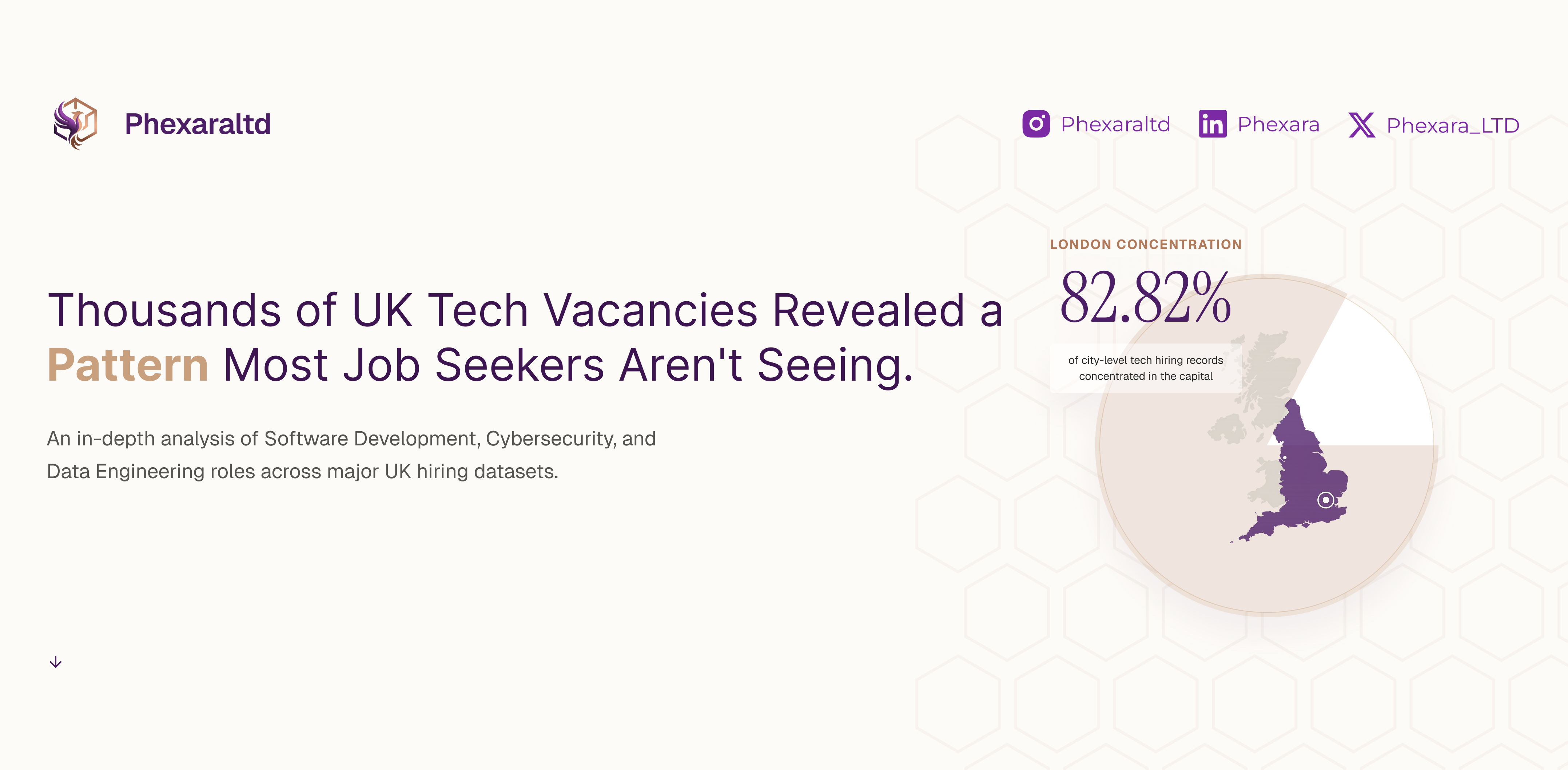
At the city level, the concentration becomes even more striking. London accounted for 82.82% of city-level records, while Manchester represented 8.73% and Leeds accounted for 8.45%. These figures effectively transformed London from a preferred market into a strategic necessity. The report therefore recommends London as the first employer-partnership market, with Manchester and Leeds identified as expansion opportunities during a second deployment phase.
Many organizations continue to pursue broad-market expansion strategies because national rollouts create the appearance of scale. The report challenges that assumption by advocating a more disciplined approach. Concentrating resources where employers are already clustered increases the probability of successful partnerships, strengthens candidate-placement opportunities, and generates more reliable evidence for future expansion decisions. In other words, the report argues for depth before breadth.
Hiring Patterns Across Time Support a Phased Deployment Strategy
Another overlooked aspect of the analysis involves temporal movement within the labor market. Vacancy demand did not follow a predictable upward trajectory. Instead, it demonstrated substantial fluctuations over a relatively short period. Adzuna data showed vacancies peaking at approximately 37,800 in November 2025 before declining by 32.3% to approximately 25,600 in June 2026. July 2026 then recorded a modest recovery to 26,700 vacancies.
Such movements make it impossible to consider the strategic meaning of the findings in the same manner. As long as labor markets tend to fluctuate in connection with changes in economic circumstances, it becomes impossible to base the process of deploying products on any stable factors. It is necessary to develop mechanisms of ongoing monitoring that would be able to detect variations in vacancy rates, in active-to-expired rates, and in geography of demand.
This recommendation also explains why the report favors a staged launch rather than an aggressive expansion model. Pilot programs create opportunities to test assumptions, gather evidence, refine methodologies, and adjust implementation strategies before significant resources are committed.
The Most Important Discovery Is the Evidence Gap Between Candidates and Employers
Buried within the diagnostic section of the report is a statement that fundamentally reframes the entire technology hiring conversation. Candidates need credible work evidence, while employers need vetted qualifications they can trust. This observation identifies what may be the most persistent challenge within modern technology recruitment.
The traditional hiring model assumes that qualifications function as reliable proxies for competence. The report suggests otherwise. Educational credentials, certifications, and job titles often fail to communicate practical capability in ways that employers consider trustworthy. At the same time, candidates who possess genuine technical skills frequently struggle to translate those abilities into measurable evidence during recruitment processes.
Phexara's proposed framework attempts to resolve this tension by creating an assessment model built around observable outcomes rather than descriptive claims. Software Development assessments would emphasize code quality, testing, and deployment. Data Engineering evaluations would prioritize pipelines, data reliability, and cloud outputs. Cybersecurity assessments would focus on incident response, penetration-testing methodologies, and documentation. Instead of asking candidates to explain what they know, the model asks them to demonstrate what they can accomplish.
This shift from credentials toward evidence may ultimately become the report's most enduring contribution because it offers a practical solution to a problem affecting both employers and job seekers.
The 90-Day Pilot Represents a Test of an Entirely Different Hiring Philosophy
The report concludes with a proposal for a 90-day pilot program built around Software Development, Data Engineering, and Cybersecurity. The pilot would operate within London and the broader English market while relying on employer-relevant projects, reviewer evidence, and capability records that could be shared directly with hiring partners. Success would be measured through employer engagement, verified project completion, and candidate performance.
The projected outcomes are ambitious but deliberately measurable. The report anticipates more than 200 verified candidate placements, at least 15 employer partnerships, and a validated evidence framework capable of supporting nationwide expansion. The proposed staffing model remains intentionally lean, requiring four to five full-time personnel, including a program lead, three curriculum and assessment specialists, and one or two employer-partnership managers responsible for London outreach.
What makes this proposal particularly compelling is that it treats hiring as an engineering problem rather than an administrative process. Hypotheses are tested. Evidence is collected. Outcomes are measured. Models are refined. This iterative philosophy aligns naturally with the technology sector itself and may offer a more effective alternative to traditional recruitment systems.
Conclusion: The Future of Technology Hiring Will Belong to Organizations That Can Verify Capability
Indeed, several methodological issues must be considered when evaluating the results presented in the report. They include classification discrepancies, coverage deficiencies, duplications, and restrictions imposed by the data sources. Still, the results obtained are better to be perceived as indicative of observed recruitment trends rather than precise estimates of hiring activity on the UK labor market in general. At the same time, consistency of results found across a number of different sources allows making some conclusions.
Software Development, Data Engineering, and Cybersecurity are among the most promising areas in terms of immediate deployment. London seems to be the most reasonable starting point for engaging employers. Quarterly monitoring represents an effective way of dealing with the market volatility. However, such results are used to make a bigger point.
It is becoming increasingly difficult to recruit specialists in technology using only credentials. Increasingly, employers ask for the proof of ability to turn skills into measurable results, while applicants have to find ways to do so. Companies able to solve this problem will gain much more than just an improved hiring process.
Access the full report.
For more Insights and nugget, follow us on Twitter (X), LinkedIn and Instagram.
Want to talk about how this applies to your organisation?
Contact Us